Showing posts with label konkani GSB. Show all posts

Saturday, July 9, 2011

Mergole - Sweet Potato Paaysu


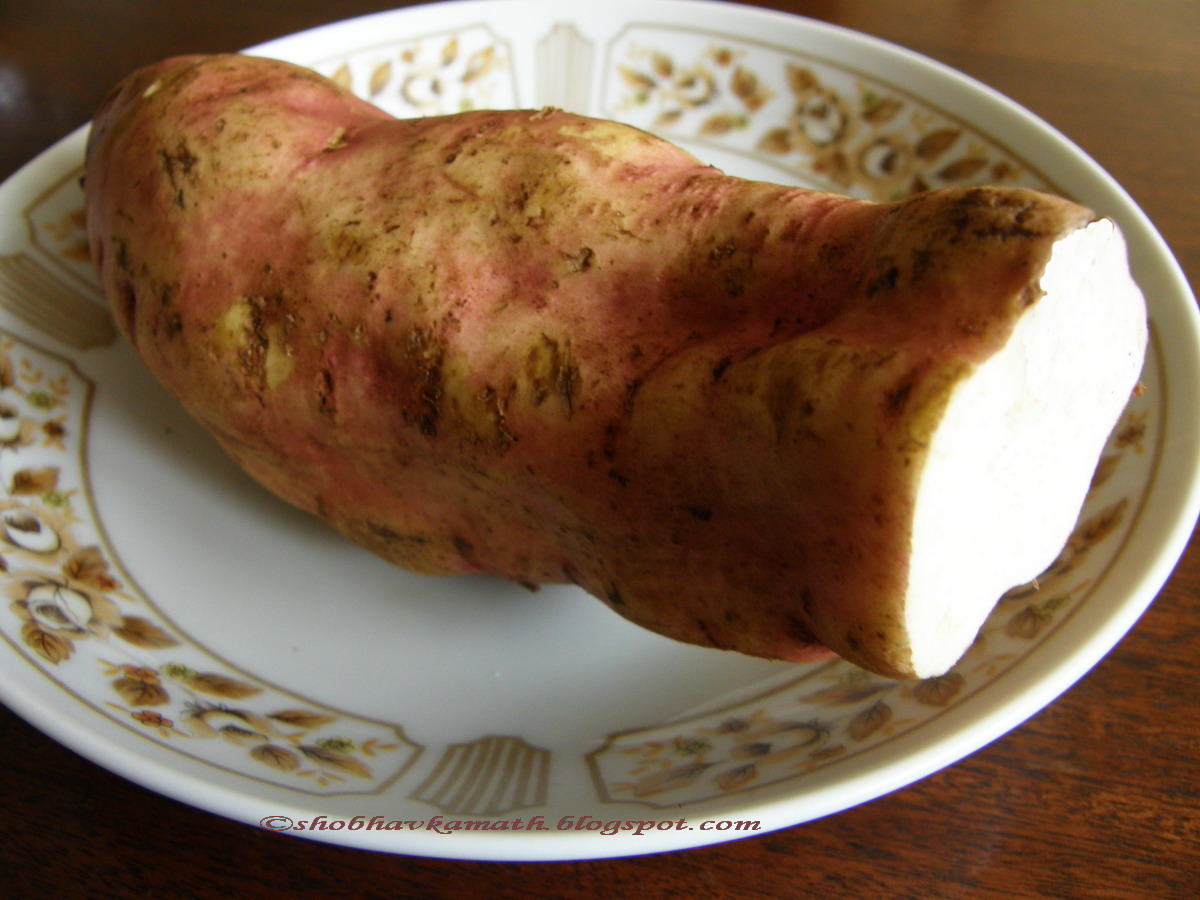
“Mergole” is the Konkani name for this sweet dish made from the tuber Kananga (Konkani), Ratallu (Marathi) or Sweet Potato (English). This is typically a Manglorean or coastal Karnataka dish.  I wanted to make this simple long forgotten paayasu and hence I had kept a small piece aside (after preparing the “Kananga Daaddau”), so that I can share this simple and tasty and easy to prepare dish.

I have used here the coconut milk pack (less work for the lazy me!) instead of the usual coconut gratings wherein you need to grind it with a little water and then strain the juice to make coconut milk. I do admit though that the fresh coconut milk does make a difference to the taste of the dish especially if one is of the “Jibbe Ruchi”  type of person (generally all Amchis are !).


Sweet Potato Paaysu


Ingredients

Sweet Potato (small)
1
Coconut milk
150 ml (11/2 cup)
Jaggery (molasses) powder
3 tbsps  or as per taste
Salt
A pinch
Cardamom powder
1 tsp
Cashews (halved & roasted in ghee)-optional
6 (whole)
Raisins (roasted in ghee) - optional
8-10


Method:


  1. Wash and skin the sweet potato. Cut it onto small cubes.
  2. Steam the cubed bits in a steamer or boil them in a little water till soft. This should take about 20 mins.
  3. Add salt, jaggery powder and the coconut milk to the boiled sweet potato bits and bring it to a boil.
  4. Finally add the roasted cashews, raisins and cardamom powder. Mix well and remove from flame.
  5. Serve hot.

Serves: 2


Sweet Potato - Raw
Sweet Potato - cut into cubes


         Note:

  • This dish can be served hot or cold. The choice is yours.
  • Traditionally the sweet potato is cut into cubes (you may grate it if you wish) and the skin is not removed. Here, I removed it as the skin had lot of blemishes.
  • It is advisable to dissolve the powdered jaggery in water and strain it so as to remove any insoluble impurities.

Friday, June 24, 2011

"Haldi Paana Patholi" (Turmeric Leaf Patholi)


“Haldi Paan” is a Konkani word for Turmeric leaf and “Patholi” is the name of the sweet dish that is prepared by using the Haldi paan. These leaves are very aromatic and this aroma is transferred to the sweet dish. The leaves as such are not eaten.

For the konkanis, however, patholi is a delicacy and is a must in the menu during some of our religious functions for eg. “Vyna Puja” (Gauri Puja) &  Chavathi (Ganesh Chaturthi) to name a few. I believe this must have become a norm as the availability of the leaves is in plenty during the monsoon and these festivals are celebrated during the rainy season.


Patholi
Steaming hot "Patholi"in a platter

Patholi 4
Steaming hot patholi just out of steamer


Patholi 2
 Haldi Paan with the rice batter and coconut-jaggery filling

Patholi 3
Haldi Paan (with the batter and filling inside) folded and ready for steaming


Ingredients:

Turmeric leaves
10 -12
Rice
½ cup or about 100gms
Beaten rice (Poha)
½ cup
Coconut scrapings
¾ cup
Salt
A pinch
Powdered Jaggery (molasses)
2 tbsps
Cardamom powder
1-2 tsps
           

Method :

  1. Wash and soak the rice and beaten rice for an hour.
  2. Grind this with a tablespoon of coconut scrapings, salt and half a tablespoon of powdered jaggery to a smooth paste without adding any water.
  3. Mix the remaining (powdered jaggery, coconut scrapings) and cardamom powder and keep aside.
  4. Wash and wipe clean the turmeric leaves and place the leaves with the front side facing upwards.
  5. Divide the ground paste into 10 -12 portions (depending on the quantity of turmeric leaves being used)
  6. Spread the ground paste thinly onto each leaf.
  7. Take little quantity of the jaggery, cardamom & coconut mixture and spread it lengthwise in the centre of the leaf in a straight line and fold the leaf lengthwise.
  8. Follow this procedure for all the leaves. Then, gently place these folded leaves (taking care to see that the batter does not come out from the leaf) in a (preheated) cooker or steamer and steam for about 15 mins.
  9. When done, remove from the cooker /steamer and serve hot.


Instructions for serving:
Patholi is generally served hot as it is (with the leaf) or the leaf can be peeled off and then served. It is eaten with a dollop of ghee (clarified butter) on top of each patholi (after the leaf has been peeled off) as this enhances its taste.

Note: 
  • I used the organic jaggery (dark colour) instead of the usual golden colour jaggery.
  • If the steaming of these “patholis” is done in the cooker, remove the whistle of the cooker and steam them as you would do for normal “idlis”.
  • Jackfruit patholi is prepared in a slightly different way. The recipe can be found in my earlier posts.

    Idli made from "patholi" batter
    Since I had fewer Haldi paan, I utilised the leftover batter and the coconut jaggery mixture by making idlis.

    I smeared the idli mould with ghee and placed a spoonful of this batter and topped it with the coconut-jaggery mixture and steamed it as I would for the normal idlis. Believe me, it tasted quite good as my hubby gobbled it up in a jiffy!


    Sunday, September 19, 2010

    Janmashtami Puja

    As I mentioned in my previous post, Shravana month is a very busy month in India with a lot of festivals lined up which literally means, specific mouth-watering dishes apart from the religious aspect of it.


    One such festival is Krishna Janmashtami which means Lord Shri Krishna’s birthday. All over India, this is an auspicious day and is celebrated with great pomp and devotion. In the olden days, on this day, the elders in the family will narrate stories of Krishna’s childhood activities to the children who will gather around them to hear with rapt attention.


    We too celebrated this festival at home on Sept. 01, 2010. in a grand way starting with the decoration of the “Mantap” and collecting all the paraphernalia needed for the pooja like fruits, flowers, tulsi, the brass and silver lamps, aartis etc. Full credit goes to my daughter (spent a few hours to get it right) for the elaborate decoration of "Mantap".


    Janmashtami Puja 2010


    The Puja is performed at night since Lord Krishna was born at midnight. During the day all members of the family observe fasting. In GSB Konkani community “fasting” means avoiding rice, onion, garlic and non-veg items. Partaking of fruits, milk and certain dishes made out of semolina are allowed before the “pooja”. Thank God for this small mercy as it would have been impossible for me to prepare so many items on an empty stomach !!


    Varities of food preparation and prasadam etc are cooked during the day to be offeredto the Lord. After the puja, all the family members will eat served on plantain leaves.


    served on plantain leaf


    Traditionally the following food items are prepared in GSB (Konkani) community on this day.

    Tendle & Bibbe Upkari, Channa Ghashi, Dalithoy, Vul-Vul / Yogiratna, Soorna Thambude, patradau etc., varities of phodis and for “Naivedya” such as Panchkajjai, Madagane, Sheera /Oondau, Mooga Dali Usli etc.


    The recipes for some of the above mentioned dishes have already been posted on my blog.


    I shall start with the Panchakajjai recipe. “Panchkajjai” literally means a mixture of five ingredients. This is supposed to be one of Krishna’s favourite sweet dish. But believe me it happens to be everybody’s favorite prasadam! Its so tasty, that as soon as we start distributing, it vanishes in no time!


    Panchkajjai


    Ingredients:


    Split Bengal gram (channa dal)

    1 cup

    Freshly grated coconut

    1 heaped cup

    Powdered Jaggery

    ¾ cup

    Til (sesame) seeds

    2 tbsps

    Cardamom powder

    2 tsps


    Method :


    1. Roast the channa dal (split gram) till brown and grind it like fine semolina (sooji) and keep aside.
    2. Wash and roast sesame (til) seeds and keep aside.
    3. In a bowl, mix together the freshly grated coconut, powdered jaggery and cardamom powder (preferably by hand).
    4. Add to it the gram powder and the roasted til. Mix well.


    Serves: 6-8


    Note:

    • A tablespoon of ghee if added to the above panchkajjai mixture, will enhance its taste further.
    • Since freshly grated coconut is used, this dish should be consumed within 2-3 days.
    • Quantity of jaggery powder can be increased according to one's taste.